[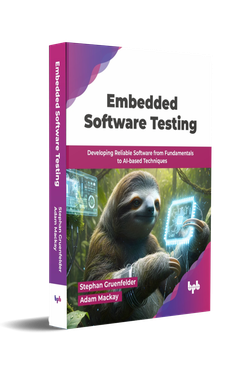](https://mybook.to/Embedded-Software-Test)
**Stephan Grünfelder & Adam Mackay**
*BPB Publications, 2026 · ISBN 936589428X*
The definitive practical guide to testing safety-critical embedded software in an AI-augmented world — distilled from decades of hard-won experience in aerospace, automotive, nuclear, and medical domains.
[Buy Kindle / eBook](https://mybook.to/Embedded-Software-Test) [Buy Print](https://mybook.to/Embedded-Software-Book)
---
## About the Book
Embedded software differs from conventional PC software in one fundamental way: it is part of a product, not the product itself. The tasks of these systems are extraordinarily diverse — from vending machines and automotive control units to life-sustaining medical devices. When they fail, the consequences extend well beyond a bad quarterly report.
This book explains proven practical methods for testing embedded software at every stage of development. It shows which review, analysis, and testing methods apply at which point, and presents tools and case studies drawn from industrial practice.
In addition to general software testing techniques, the book covers topics specific to the embedded domain: testing in resource-constrained environments, real-time verification, hardware-software interaction analysis, testing standards, and liability risk. The final chapters address how AI-based techniques are entering the field of embedded testing — and where the limits lie.
After reading this book, you will be equipped to design, implement, and manage testing strategies for both low- and high-integrity embedded software. Exercises and solutions throughout build the skills needed to tackle complex testing challenges in real projects.
---
## What You'll Learn
- Fundamental and advanced embedded software testing techniques across the full development lifecycle
- Testing at every level: unit, integration, system, RTOS, and middleware
- Real-time verification and worst-case execution time analysis
- Schedulability analysis for concurrent and distributed real-time systems
- Hardware-software interaction analysis grounded in FMEA
- Model-based testing, trace data analysis, and static code analysis
- Where AI can accelerate test tasks — and where it cannot
- Software testing liability risk in the EU and internationally
---
## Chapter Overview
Twenty chapters across the full testing lifecycle.
**Foundations (Chapters 1–5)** — Testing concepts and ISTQB/ISO standards, requirements engineering (including the EARS method and AI assistance), software design review, automatic static code analysis, and code review techniques.
**Dynamic Testing (Chapters 6–9)** — Black-box testing techniques (equivalence partitioning, boundary value analysis, state-based testing), unit testing with MC/DC coverage, integration testing (software/software and hardware/software), and comprehensive system testing across functional, performance, security, and recovery dimensions.
**Embedded-Specific Topics (Chapters 10–16)** — RTOS and middleware testing, concurrency issues (data races, deadlocks), worst-case execution time analysis, schedulability analysis for real-time systems, hardware-software interaction analysis, model-based testing, and trace data analysis for non-intrusive coverage measurement.
**AI and Management (Chapters 17–20)** — AI-based testing techniques (LLMs, prompt engineering, retrieval-augmented generation for test generation), test management, quality management, and software testing liability risk.
---
## The Authors
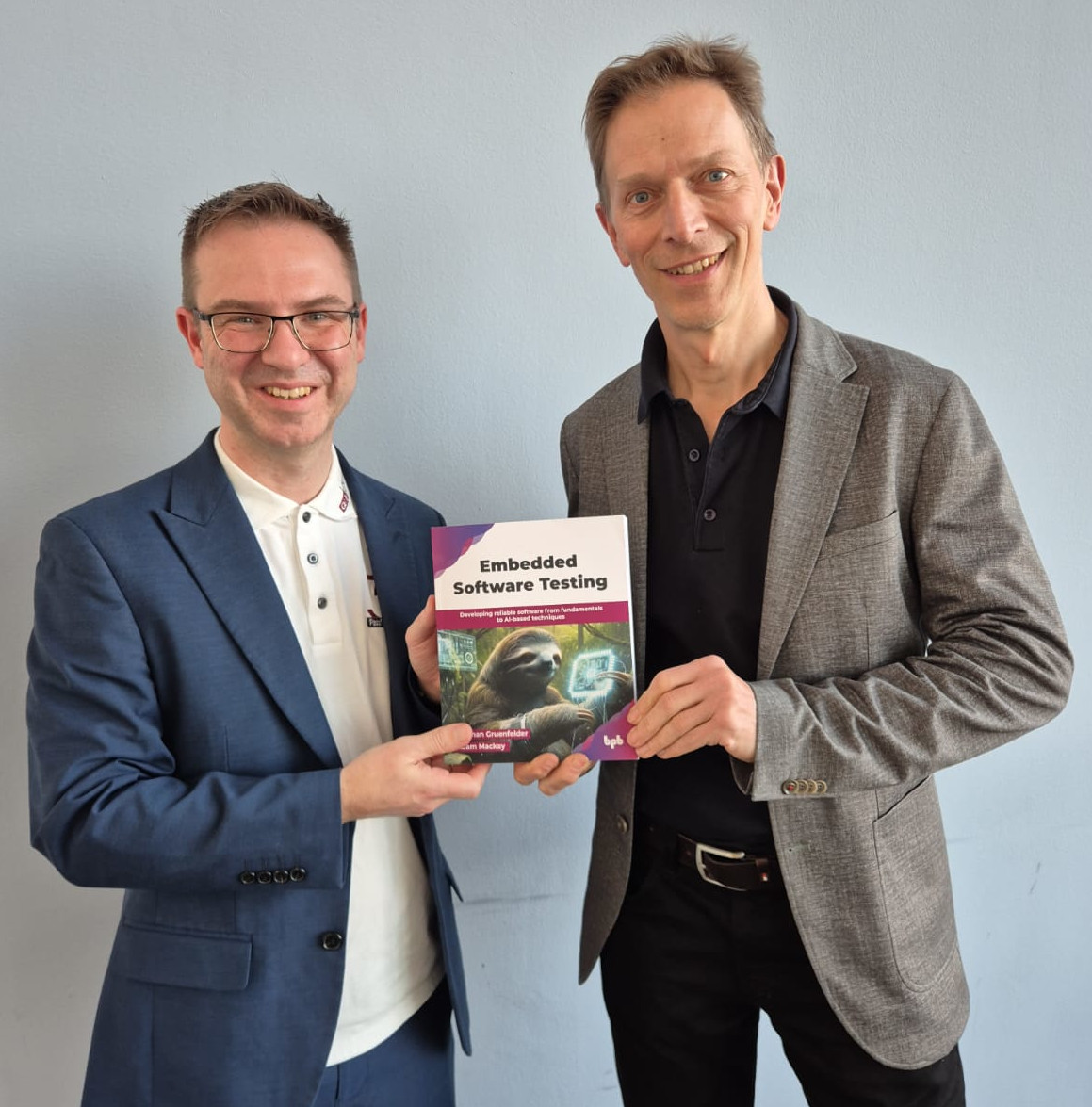
**Stephan Grünfelder** has a background as a programmer and tester in unmanned spaceflight and medical technology, later as project manager for control unit development in the automotive sector. He now works independently as a trainer for software testing and senior software tester for broadcast equipment, with academic appointments at Reykjavik University, the University of Applied Sciences Technikum Wien, and the Technical University of Vienna. His clients span from London to Bangalore.
**Adam Mackay** has over two decades of experience in regulated and safety-critical technology spanning aerospace, automotive, and healthcare. Currently Head of AI and Principal Strategic Advisor at QA-Systems, he leads initiatives advancing AI application in safety-critical environments. He holds a Master of Engineering with Honours from the University of Bath and contributes to the embedded systems community through writing, speaking, and conference presentations.
---
[← Back to Writing](writing.html)